Tuesday, March 4, 2008

the elf in my head makes breadsticks


With my credentials of being a pseudo-scientist, I now declare myself a quack health practitioner. As my first act under this vague and highly questionable title, I would like to identify a disease I have observed in the local area:
Phantom Wife Syndrome: an affliction of the male population that is brought about by feelings of insecurity, isolation, desperation, and despair. Generally these feelings are dependent on two factors. First, the patient will usually be living in an area in which males greatly outnumber females. The ensuing difficulty of finding a mate, much less a suitable mate, will create feelings of frustration and self-doubt, leading to desperation and despair. This on its own, however is not enough to qualify as PWS, and would be better classified as an inadequacy of self-esteem. Secondly, the patient will usually already have multiple responsibilities such as owning a house, being a parent, having a steady job, or owning his own business. In many cases, these will be remnants of a former serious relationship that has recently ended. In a few cases the patient will be relatively unburdened, but long for these "traditional" responsibilities because of a Security Illusion Complex (often a precursor to Phantom Wife Syndrome) wherein the patient believes that a certain possession (i.e. house, car, etc…) or lifestyle (i.e. living behind a white picket fence) is all that is necessary to protect him from emotional or financial hardships. 

When a patient develops PWS, he will become immediately infatuated with any woman who crosses his path and seems even the slightest bit suitable for marriage. He will use a string of logical fallacies to justify the depth of his premature emotional attachment, for example: She's been married before, therefore she must be a good wife. She has nice hair, therefore she must be a nice person. She doesn't have a criminal record, therefore she must love children. And so on. If the syndrome goes untreated for even a short amount of time, the patient will build up an entirely imaginary person in his mind and superimpose it on his mate. Anytime the real woman acts in a way which conflicts with the man's imaginary ideal, he will simply ignore it, choosing instead to amplify the significance of incidences where the real and imaginary coincide. In extreme cases where the imagined ideal and actual person conflict excessively, the man may become resentful, even violent, feeling he has somehow been tricked by the woman when actually he has only been fooling himself. 

The treatment for Phantom Wife Syndrome is a combination of Reality and Self-Esteem. The patient must come to terms with the fact that there is no absolute security. No matter how much material wealth a person may acquire, that person can still be stripped of any or all of his possessions at any moment. No matter how happy or loved a person is, that person will still have to grapple with emotional turmoil sooner or later. The patient must also cultivate and learn to rely on his own strength. He must come to the understanding that he has to be able to depend on himself before he can ask another person to depend on him and before he can  responsibly and reasonably become dependent on another.

I am absolutely certain that a similar syndrome involving feelings of inadequacy and desperation and the false belief in absolute stability afflicts women (as Phantom Husband Syndrome) and homosexuals. However, being a woman living in a population with an overwhelming male majority, I have only had personal experience with PWS and feel unqualified to satisfactorily explain the exact causes behind these alternate syndromes. Perhaps after more and better research into these areas I will further my mock career by describing them as well. In any case, they are all diseases of the spirit born out of loneliness and loneliness is something that affects us all. So, as my second act as an unspecified practitioner of hooey I would like to prescribe a series of preventative treatments:

First, know yourself, respect yourself, be yourself. This isn't always easy and people don't actually always admire you for your self-confidence as countless grade school teachers would have you believe, but feeling comfortable in your own skin is priceless and well worth any ridicule. Secondly, make as many friends as you can. Having a network of like-minded (or sometimes different-minded) and sympathetic people offers far more stability than a spouse, no matter how loving, ever could. And, in my experience at least, friendships tend to last longer than romantic relationships or even marriages. Finally, abandon the materialistic attitude. Having nice things can make life easier and more enjoyable, but that hole in your heart isn't there for want of a new car. Accurately identify your troubles before you go indiscriminately throwing money at them. Many problems cannot be solved by money, some can. Know the difference and act accordingly.

Saturday, March 1, 2008

canoes are for finches


here is an article i found on http://www.buddhanet.net about homosexuality and buddhism. it also goes into more detail about the third part of the fourth fold of the buddhist eightfold path, which i posted in a previous blog, a sandbag becomes a spring, as meaning "Practice self control and do not abuse the senses or do not be unchaste". those are the two translations i have found in books, but its important to remember that the Buddha taught the foundational principles of moderation in all things (the middle path) and tolerance. i've been wanting to find some elaborations on the steps of the eightfold path because a straight translation doesn't always give a clear meaning, especially when seen out of context and here is an excellent opportunity to do just that!
Homosexuality and Theravada Buddhism
by A. L. De Silva
Buddhism teaches to, and expects from, its followers a certain level of ethical behaviour. The minimum that is required of the lay Buddhist is embodied in what is called the Five Precepts (panca sila), the third of which relates to sexual behaviour. Whether or not homosexuality, sexual behaviour between people of the same sex, would be breaking the third Precept is what I would like to examine here.
Homosexuality was known in ancient India; it is explicitly mentioned in the Vinaya (monastic discipline) and prohibited. It is not singled out for special condemnation, but rather simply mentioned along with a wide range of other sexual behaviour as contravening the rule that requires monks and nuns to be celibate. Sexual behaviour, whether with a member of the same or the opposite sex, where the sexual organ enters any of the bodily orifices (vagina, mouth or anus), is punishable by expulsion from the monastic order. Other sexual behaviour like mutual masturbation or interfemural sex, while considered a serious offense, does not entail expulsion but must be confessed before the monastic community.
A type of person called a pandaka is occasionally mentioned in the Vinaya in contexts that make it clear that such a person is some kind of sexual non-conformist. The Vinaya also stipulates that pandakas are not allowed to be ordained, and if, inadvertently, one has been, he is expelled. According to commentary, this is because pandakas are "full of passions, unquenchable lust and are dominated by the desire for sex." The word pandaka has been translated as either hermaphrodite or eunuch, while Zwilling has recently suggested that it may simply mean a homosexual. It is more probable that ancient Indians, like most modern Asians, considered only the extremely effeminate, exhibitionist homosexual (the screaming queen in popular perception) to be deviant while the less obvious homosexual was simply considered a little more opportunistic or a little less fussy than other 'normal' males. As the Buddha seems to have had a profound understanding of human nature and have been remarkably free from prejudice, and as there is not evidence that homosexuals are any more libidinous or that they have any more difficulties in maintaining celibacy than heterosexuals, it seems unlikely that the Buddha would exclude homosexuals per se from the monastic life. The term pandaka therefore probably does not refer to homosexuals in general but rather to the effeminate, self-advertising and promiscuous homosexual.
The lay Buddhist is not required to be celibate, but she or he is advised to avoid certain types of sexual behaviour. The third Precept actually says: 'Kamesu micchacara veramani sikkhapadam samadiyami.' The word kama refers to any form of sensual pleasure but with an emphasis on sexual pleasure and a literal translation of the precept would be "I take the rule of training (veramani sikkhapadam samadiyami) not to go the wrong way (micchacara) for sexual pleasure (kamesu)". What constitutes "wrong" will not be clear until we examine the criteria that Buddhism uses to make ethical judgments.
No one of the Buddha's discourses is devoted to systematic philosophical inquiry into ethics such as one finds in the works of the Greek philosophers. But it is possible to construct a criterion of right and wrong out of material scattered in different places throughout the Pali Tipitaka, the scriptural basis of Theravada Buddhism. The Buddha questioned many of the assumptions existing in his society, including moral ones, and tried to develop an ethics based upon reason and compassion rather than tradition, superstitions and taboo. Indeed, in the famous Kalama Sutta he says that revelation (anussana), tradition (parampara), the authority of the scriptures (pitakasampada) and one's own point of view (ditthinijjhanakkhanti) are inadequate means of determining right and wrong.
Having questioned the conventional basis of morality, the Buddha suggests three criteria for making moral judgments. The first is what might be called the universalisability principle - to act towards others the way we would like them to act towards us. In the Samyutta Nikaya he uses this principle to advise against adultery. He says: "What sort of Dhamma practice leads to great good for oneself?... A noble disciple should reflect like this: 'If someone were to have sexual intercourse with my spouse I would not like it. Likewise, if I were to have sexual intercourse with another's spouse they would not like that. For what is unpleasant to me must be unpleasant to another, and how could I burden someone with that?' As a result of such reflection one abstains from wrong sexual desire, encourages others to abstain from it, and speaks in praise of such abstinence."
In the Bahitika Sutta, Ananda is asked how to distinguish between praiseworthy and blameworthy behaviour. He answers that any behaviour which causes harm to oneself and others could be called blameworthy while any behaviour that causes no harm (and presumably which helps) oneself and others could be called praiseworthy. The suggestion is, therefore, that in determining right and wrong one has to look into the actual and possible consequences of the action in relation to the agent and those affected by the action. The Buddha makes this same point in the Dhammapada: "The deed which causes remorse afterwards and results in weeping and tears is ill-done. The deed which causes no remorse afterwards and results in joy and happiness is well-done." This is what might be called the consequential principle, that behaviour can be considered good or bad according to the consequences or effects it has.
The third way of determining right and wrong is what might be called the instrumental principle, that is, that behaviour can be considered right or wrong according to whether or not it helps us to attain our goal. The ultimate goal of Buddhism is Nirvana, a state of mental peace and purity and anything that leads one in that direction is good. Someone once asked the Buddha how after his death it would be possible to know what was and was not his authentic teaching and he replied: "The doctrines of which you can say: 'These doctrines lead to letting go, giving up, stilling, calming, higher knowledge, awakening and to Nirvana' - you can be certain that they are Dhamma, they are discipline, they are the words of the Teacher."
This utilitarian attitude to ethics is highlighted by the fact that the Buddha uses the term kusala to mean 'skillful' or 'appropriate' or its opposite, akusala, when evaluating behaviour far more frequently than he uses the terms punna, 'good', or papa, 'bad'. The other thing that is important in evaluating behaviour is intention (cetacean). If a deed is motivated by good (based upon generosity, love and understanding) intentions it can be considered skillful. Evaluating ethical behaviour in Buddhism requires more than obediently following commandments, it requires that we develop a sympathy with others, that we be aware of our thoughts, speech and actions, and that we be clear about our goals and aspirations.
Having briefly examined the rational foundations of Buddhist ethics we are now in a better position to understand what sort of sexual behaviour Buddhism would consider to be wrong or unskillful and why. The Buddha specifically mentions several types of unskillful sexual behaviour, the most common of which is adultery. This is unskillful because it requires subterfuge and deceit, it means that solemn promises made at the time of marriage are broken, and it amounts to a betrayal of trust. In another passage, the Buddha says that someone practicing the third Precept "avoids intercourse with girls still under the ward of their parents, brothers, sisters or relatives, with married women, with female prisoners or with those already engaged to another." Girls still under the protection of others are presumably too young to make a responsible decision about sex, prisoners are not in a position to make a free choice, while an engaged woman has already made a commitment to another. Although only females are mentioned here no doubt the same would apply to males in the same position.
As homosexuality is not explicitly mentioned in any of the Buddha's discourses (more than 20 volumes in the Pali Text Society's English translation), we can only assume that it is meant to be evaluated in the same way that heterosexuality is. And indeed it seems that this is why it is not specifically mentioned. In the case of the lay man and woman where there is mutual consent, where adultery is not involved and where the sexual act is an expression of love, respect, loyalty and warmth, it would not be breaking the third Precept. And it is the same when the two people are of the same gender. Likewise promiscuity, license and the disregard for the feelings of others would make a sexual act unskillful whether it be heterosexual or homosexual. All the principles we would use to evaluate a heterosexual relationship we would also use to evaluate a homosexual one. In Buddhism we could say that it is not the object of one's sexual desire that determines whether a sexual act is unskillful or not, but rather the quality of the emotions and intentions involved.
However, the Buddha sometimes advised against certain behaviour not because it is wrong from the point of view of ethics but because it would put one at odds with social norms or because its is subject to legal sanctions. In these cases, the Buddha says that refraining from such behaviour will free one from the anxiety and embarrassment caused by social disapproval or the fear of punitive action. Homosexuality would certainly come under this type of behaviour. In this case, the homosexual has to decide whether she or he is going to acquiesce to what society expects or to try to change public attitudes. In Western societies where attitudes towards sex in general have been strongly influenced by the tribal taboos of the Old Testament and, in the New Testament, by the ideas of highly neurotic people like St. Paul, there is a strong case for changing public attitudes.
We will now briefly examine the various objections to homosexuality and give Buddhist rebuttals to them. The most common Christian and Muslim objection to homosexuality is that it is unnatural and "goes against the order of nature". There seems to be little evidence for this. Miriam Rothschild, the eminent biologist who played a crucial role in the fight to decriminalize homosexuality in Britain, pointed out at the time that homosexual behaviour has been observed in almost every known species of animal. Secondly, it could be argued that while the biological function of sex is reproduction, most sexual activity today is not for reproduction, but for recreation and emotional fulfillment, and that this too is a legitimate function of sex. This being so, while homosexuality is unnatural in that it cannot leads to reproduction, it is quite natural for the homosexual in that for her or him it provides physical and emotional fulfillment. Indeed, for him or her, heterosexual behaviour is unnatural. Thirdly, even if we concede that homosexuality "goes against the order of nature", we would have to admit that so do many other types of human behaviour, including some religious behaviour. The Roman Catholic Church has always condemned homosexuality because of its supposed unnaturalness - but it has long idealized celibacy, which, some might argue, is equally unnatural. Another Christian objection to homosexuality is that it is condemned in the Bible, an argument that is meaningful to those who accept that the Bible is the infallible word of God, but which is meaningless to the majority who do not accept this. But while there is no doubt that the Bible condemns homosexuality, it also stipulates that women should be socially isolated while menstruating, that parents should kill their children if they worship any god other than the Christian God and that those who work on the Sabbath should be executed. Few Christians today would agree with these ideas even though they are a part of God's words, and yet they continue to condemn homosexuality simply because it is condemned in the Bible.
One sometimes hears people say: "If homosexuality were not illegal, many people, including the young, will become gay." 'This type of statement reflects either a serious misunderstanding about the nature of homosexuality or perhaps a latent homosexuality in the person who would make such a statement. It is as silly as saying that if attempted suicide is not a criminal offense then everyone will go out and commit suicide. Whatever the cause of homosexuality (and there is great debate on the subject), one certainly does not 'choose' to have homoerotic feelings in the same way one would, for example, choose to have tea instead of coffee. It is either inborn or develops in early childhood. And it is the same with heterosexuality. Changing laws does not change people's sexual inclinations.
Some have argued that there must be something wrong with homosexuality because so many homosexuals are emotionally disturbed. At first there seems to be some truth in this. In the West, at least, many homosexuals suffer from psychological problems, abuse alcohol, and indulge in obsessive sexual behaviour. As a group, homosexuals have a high rate of suicide. But observers have pointed out that such problems seem to be no more pronounced amongst African and Asian homosexuals than they are in the societies in which they live. It is very likely that homosexuals in the West are wounded more by society's attitude to them than by their sexual proclivity, and, if they are treated the same as everybody else, they will be the same as everybody else. Indeed, this is the strongest argument for acceptance and understanding towards homosexuals.
Christianity grew out of and owes much to Judaism with its tradition of fiery prophets fiercely and publicly denouncing what they considered to be moral laxity or injustice. Jesus was very much influenced by this tradition, as have been the Christian responses to public and private morality generally. At its best, this tradition in Christianity to loudly denounce immorality and injustice has given the West its high degree of social conscience. At its worst, it has meant that those who did not or could not conform to Christian standards have been cruelly exposed and persecuted. The Buddhist monk's role has always been very different from his Christian counterpart. His job has been to teach the Dhamma and to act as a quiet example of how it should be lived. This, together with Buddhism's rational approach to ethics and the high regard it has always given to tolerance, has meant that homosexuals in Buddhist societies have been treated very differently form how they have been in the West. In countries like China, Korea and Japan where Buddhism was profoundly influenced by Confucianism, there have been periods when homosexuality has been looked upon with disapproval and even been punishable under the law. But generally the attitude has been one of tolerance. Matteo Ricci, the Jesuit missionary who lived in China for twenty-seven years from 1583, expressed horror at the open and tolerant attitude that the Chinese took to homosexuality and naturally enough saw this as proof of the degeneracy of Chinese society. "That which most shows the misery of these people is that no less than the natural lusts, they practise unnatural ones that reverse the order of things, and this is neither forbidden by law nor thought to be illicit nor even a cause for shame. It is spoken of in public and practiced everywhere without there being anyone to prevent it." In Korea the ideal of the hwarang (flower boy) was often associated with homosexuality especially during the Yi dynasty. In Japan, a whole genre of literature (novelettes, poems and stories) on the love between samurais and even between Buddhist monks and temple boys developed during the late mediaeval period.
Theravada Buddhist countries like Sri Lanka and Burma had no legal statutes against homosexuality between consenting adults until the colonial era when they were introduced by the British. Thailand, which had no colonial experience, still has no such laws. This had led some Western homosexuals to believe that homosexuality is quite accepted in Buddhist countries of South and South-east Asia. This is certainly not true. In such countries, when homosexuals are thought of at all, it is more likely to be in a good-humored way or with a degree of pity. Certainly the loathing, fear and hatred that the Western homosexual has so often had to endure is absent and this is due, to a very large degree, to Buddhism's humane and tolerant influence.

Wednesday, February 27, 2008

zebras always fall


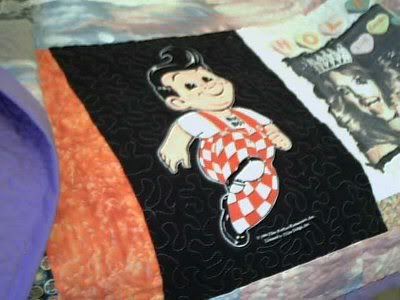
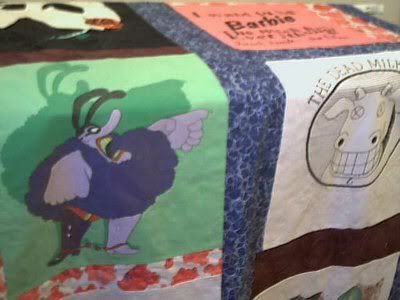
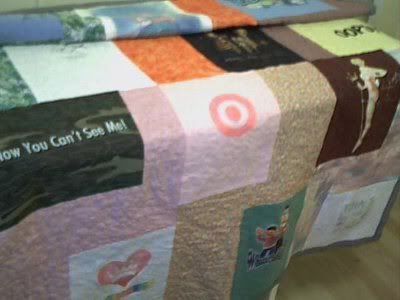
again, i have finished some quilts. i had the flu pretty much the whole time i've been working on these (3 weeks now) so they're kind of screwed up. but that's okay cause i was just making them for me and they look fine from the front so no one ever has to know. i won't tell if you don't. these are all pieced from old t-shirts and quilted by machine in a freehand design we quilters usually call "stippling". i like to think of it as a thread scribble. okay, pictures:
Shirty 1
 that's the only one that has fluff in the middle. i decided not to fluff the middles of the others cause i'm using them as wallhangings. they could possibly be used as baby quilts eventually if one of my friends ever has a baby and doesn't mind if their crib blanket has a picture of a vargas pin-up girl on it or says bitch on it.

Shirty 2
Shirty 3
 that's all for now. i have two more i'm working on that should be done sometime next month. please, flu, leave already.

Sunday, February 24, 2008

pointy stick for your convenience


i'm reading the book that my library categorizes as kurt vonnegut's biography and it keeps making me cough (which is how i laugh when i have the flu). its mostly new stuff, but i recognize some of these bits from his other books. here's one that i really liked from God Bless You, Dr. Kevorkian and i kept wishing i'd copied it down when i was reading that book and now it seems i have been given a second chance:

"Why are so many people getting divorced today? It's because most of us don't have extended families anymore. It used to be that when a man and a woman got married, the bride got a lot more people to talk to about everything. The groom got a lot more pals to tell dumb jokes to.

A few Americans, but very few, still have extended families. The Navahos, the Kennedys.
But most of us, if we get married nowadays, are just one more person for the other person. The groom gets one more pal, but its a woman. The woman gets one more person to talk to about everything, but its a man.
When a couple has an argument nowadays, they may think its about money or power or sex or how to raise the kids or whatever.  What they are really saying to each other, though without realizing it, is this: "You are not enough people!"

A husband, a wife, and some kids is not a family. Its a terribly vulnerable survival unit."

and on why he's upset that smoking didn't kill him:

"The last thing I ever wanted was to be alive when the three most powerful people on the whole planet would be named Bush, Dick, and Colon."

*cough* *hack* *cough*    *splutter* *cough*

Saturday, February 23, 2008

a sandbag becomes a spring


last blog, i posted the first two steps of the yogic eightfold path as described in my meditation book: the yamas (abstentions) and niyamas (observances). so, naturally this blog will contain the next 6 folds. didn't want to leave you in suspense. again, i have paraphrased mightily:

3. asana (body control): practicing yoga postures (or exercising) to keep your body strong and flexible so you can sit for long periods of time in meditation without your bodily discomfort causing a distraction. Also, yoga positions can be used as a form of "moving meditation" when your mind is fully focused on the positions.

4. pranayama (breath control): prana, the force of life that animates all living things can be taken in and replenished through the breath. Breath can also be the focus of a meditation.

5. pratyahara (detachment): learning to suppress the senses to minimize outside distractions during meditation.


6. dharana (concentration): focusing your full attention on a single point- a sight, sound, smell, or thought.

7. dhyana (meditation): going beyond concentraion and learning to quiet the mind and free it from preconceptions, illusions, and attachments.

8. samadhi (pure consciousness): an indescibable state of absolute bliss, nirvana, or enlightenment. this is the ultimate goal of meditaion for many, but even if you never reach this state, meditation can still be very rewarding.

and as long as we're all here and i have the book with me, here is the buddhist eightfold path (as described in the same book) to contrast and compare. i mostly just copied these ones:

1. Right Understanding: this step involves seeing life as impermanent and full of suffering, understanding the nature of existence and the moral law, and understanding the cycle of reincarnation that continues until the seeker has attained enlightenment.

2. Right Thought: this step requires that the mind be kept free from sensual desire, cruelty, and negative thinking. also, the mind should be ready to disregard anything that hinders its progress toward enlightenment, a single-mindedness toward liberation.

3. Right Speech: this step means not lying, gossiping, or speaking harshly of anyone. behind this step is the philosophy that thought and action are inseperable. what you speak, you will eventually live. right speech shouldn't be too loud or passionate or arouse the emotions of others. it should be calm, straightforward, sincere, unprejudiced, and kind.

4. Right Action: this step has five sub-steps:

1) Do not kill, but instead practice love and nonviolence (like in the yogic, some take it to mean vegetarianism)
2) Do not steal, but instead be generous.
3) Practice self control and do not abuse the senses (interpreted as 'Do not be unchaste' in my other book).
4) Do not lie, but instead speak with sincerity and honesty.
5) Do not drink alcohol or take intoxicating drugs, but instead be restrained and mindful.
5. Right Livelihood or Vocation: only pursue an occupation that is just, nonviolent, and not misleading to others. jobs that are traditionally viewed as "wrong living": arms dealing (including soldiers), slave trading, flesh trading (prostitution or selling meat; includes hunters and fishermen), selling intoxicating drink, selling poisons, or anything to do with financial greed. making money isn't the problem, just the selfish motivation. instead, the seeker of enlightenment should look for ways to serve humankind.

6. Right Effort: this step means working toward a better self by attempting to keep wise thoughts, words, and deeds in the forefront of the mind, while attempting to banish unhealthy or unwise thoughts, words, and deeds.


7. Right Mindfulness: keep constantly alert and aware of the state of the body, the emotions, the mind, and the intellect. mindfulness is thought to keep the seeker from being led astray by untruth. this is also a form of "living meditation" in which the intellect is kept active in order to make the seeker more in-tune with the true nature of reality.

8. Right Concentration: the goal of this step is to be able to concentrate so wholly and completely on a  single object so that all desire is overcome and true knowledge of the object is attained. With practice, right concentration can be attained and the five hindrances -sensuality, ill will, lethargy, restlessness and worry, and skeptical doubt- can be overcome. Eventually, the seeker will find the way to pure consciousness, or nirvana.

Thursday, February 21, 2008

flox

something i thought worth copying out of my book on meditation. these are the first two steps (or folds?) of the yogic eightfold path (as opposed to the buddist eightfold path). i paraphrased a bit:

1. Yamas: things that are helpful to avoid
1) ahimsa (do no harm/ nonviolence): avoid violence in your words, actions, and even your thoughts. That includes controlling your temper and not physically harming people, but it can also include avoiding negative thoughts about others or even yourself. Not eating meat is a component of this yama for many yogis because to eat meat is to be complicit in the killing of an animal.
2) satya (do not lie/truthfulness): This involves more than avoiding the big lies; it also means being truthful about the little things like not telling a secret you promised to keep. Truthfulness builds character and personal integrity.
3) asteya (do not steal): The third yama is about refusing to steal whether that means a candy bar, a million dollars, or somebody else's great idea.
4) brahmacharya (chastity/nonlust): This yama is about holding the opposite sex (*ahem* or same sex!) in high esteem and only joining physically with your partner when you can do so virtuously, in a committed and loving relationship of mutual respect. It also means rejecting casual sex and sex solely for physical pleasure.
5) aparigraha (nongreed): Reject a materialistic way of thinking and living. It's about simplicity and learning to live only on what you need. Greed can manifest itself in other ways too: monopolizing conversations, jealousy, and dissatisfaction with your place in the world (<--doesn't mean you can't have aspirations, means cultivate satisfaction with unchangeable aspects of your life.)

2. Niyamas: things that are helpful to do
1) shauca (purity): maintain a study of the sacred texts to inspire and teach you.
2) santosha (contentment): Find happiness with what you have and who you are. This doesn't mean you can't improve yourself, but it does mean re-evaluating the obstacles in your path as opportunities and taking full responsibility for your own life.
3) tapas (discipline): Doing anything on a daily basis to improve your health is disciplined.  Like practicing yoga, doing aerobics, controlling your temper, and doing daily chores. Dicipline isn't easy, but the more you cultivate it, the easier all the other yamas and niyamas will become.
4) svadhyaya (self-study): Pay attention to who you are, what you do, how you feel and think, and what you believe. Do you act according to your beliefs? If not, are they really your beliefs, or do you have others you hadn't realized? Self-study can also involve shauca (studying the sacred texts to inspire and guide you).
5) ishvara-pranidhana (devotion): Focus on the divine, whatever that means to you. It doesn't mean you have to be religious or even believe in a God (or Goddess), although that could be one meaning. It can also mean letting go of your ego and self-focus and looking outward to the highest ideal, or having a devotion to life itself.

Saturday, February 16, 2008

the smiley face parade


i just got done watching Sicko- the movie i was avoiding because i felt that in my current situation it would be too upsetting. yes, it was upsetting, but it brought home two important points:

1. it is not just people like me who are poor and uninsured that are being denied healthcare. everyone in this country (except maybe the rich and high-profile) is at risk of having what happened to me happen to them. Everyone.

2. i'm not going to die because i'm poor or because i was uninsured. i'm not being denied care because of something i did like having a poor diet or not taking vitamins or having premarital sex or not getting enough sleep or because i was depressed as a teenager or any of the other reasons my "doctors" have come up with for justifying their negligence. i'm going to die because i'm an american. not in spite of it, Because of it. and solely because i'm an american.

i don't know if michael moore is completely right. i don't know if the healthcare systems in other countries are so much better, but based on my own experience and the experience of anyone i know who has ever been ill, i do know that this system does not work. it is unfair to everyone: the citizens rich or poor, the doctors, the nurses, the pharmacists... everyone. and it has to stop.
hopefully, if we all vote for hillary clinton she'll be able to set things right. but if she doesnt' get elected, or if her system takes time to implement (and when you're fighting an illness that could kill you at whim, time is of the essence) or if any number of other impediments occur, what then? mass exodus to canada? we, the people, are strong and we hold more power than we think. i still say its up to us as individuals to come together and master our fear and demand our human dignity.
i want to know: where are the new leaders for social change?
when is the movement starting and how do i get there?

Friday, February 15, 2008

salami indy?


From http://www.spartacus.schoolnet.co.uk/USAmeredith.htm:
"James Meredith was born in Kosciusko, Mississippi, on 25th June, 1933. While attending Jackson State College (1960-62) Meredith attempted to become the first African American to gain admission to the University of Mississippi.

Twice rejected in 1961, Meredith filed a complaint with the district court on 31st May 1961. Meredith's allegations that he been denied admission because of his colour was rejected by the district court. However, on appeal, the Fifth Judicial Circuit Court reversed this ruling. By a 2 to 1 decision the judges decided that Meredith had indeed been refused admission solely because of his race and that Mississippi was maintaining a policy of educational segregation.

Meredith's admission to the University of Mississippi was opposed by state officials and students and the Attorney General, Robert Kennedy, decided to send federal marshals to protect Meredith from threats of being lynched. During riots that followed Kennedy's decision, 160 marshals were wounded (28 by gunfire) and two bystanders were killed.

Despite this opposition, Meredith continued to study at the University of Mississippi and successfully graduated in 1964. Meredith's account of this experience at the university, Three Years in Mississippi was published in 1966."
What this article doesn't say is that previously, while James Meredith was in the Air Force he saw a counsellor about his anxieties concerning racial tensions. Whenever he heard or read or thought about an episode of racial tension he would experience extreme nervousness and sometimes get an upset stomach. While some people would bow to their fear and try to insulate themselves from exposure to those kinds of situations,  he did not.

And not only did he find a way to master his fear and stand up to an unjust system instead of hiding under a rock, he did it alone. While many individuals going into potentially volatile situations would enlist the help of a Civil Rights organization beforehand, James Meredth did not. He began his mission all on his own without any outside assistance or support; just one man against the system.

To look back on it now, it reads like destiny. Well, of course he was successful. Of course they let him into school. Of course things turned out all right. He was in the right, wasn't he? How could it have turned out any other way? But that isn't how it was. Plenty of people fought on the side of good and were defeated. There was no prophecy saying that just because they loved God and stood up for themselves they would be protected. He could have just as easily ended up like Clyde Kennard who tried to enter Mississippi Southern College at Hattiesburg and was thrown off the campus. Shortly after, he was accused and convicted of stealing 5 bags of chicken feed and sent to jail. While in jail, he developed cancer and wasn't released until shortly before his death. 

All that Clyde Kennard and James Meredith wanted was an education, a chance at a better life. There were no guarantees for either of them and each of them risked their lives and liberties and overcame untold fear and hatred in the name of justice and equality. People are still risking their lives and liberties to promote equality and create better lives for all of us. Until all humans are free, none of us is free. As long as there is still unfair discrimination of any kind in the world, then all of us are oppressed. Movements and Organizations are invaluable, but ultimately it is the responsibility of the individual to stand up to oppression, wherever and whenever it is encountered, to do the right thing in the name of humanity without allies, and without assurances until we can truly be free of the invisible chains that our culture and our history wrapped around us at birth.

Sunday, February 10, 2008

flying around like a bacon crucible


Game Over.

I saw my last doctor a few days ago. No, I haven't been cured or even diagnosed. I simply reached the end of the list of doctors that my insurance will approve.

Half the so-called doctors I saw acknowledged that there was something very wrong in my body, but claimed they were not the right person to fix it. The other half tried to convince me that there wasn't anything wrong at all and so there was nothing they could be expected to do either. Some of them lied to me about test results, some of them made up lies about me and wrote them as fact in my medical record. Then they and my subsequent "doctors" used these lies as justification for denying me healthcare. I stand by my initial assertion that seeking medical help is a waste of time and resources (I hate being right).

What will I do? The only thing I can do: try to make the best of the time I have left (however long that may be) and use this crippled, compromised body to the best of my ability while I still can; keep thinking, keep reading, keep quilting. Maybe another opportunity for recovery will present itself, maybe it won't. Recovery or death, I have to prepare either way.

Part of me is still shocked and disbelieving. How could this happen? How can discrimination and irresponsibility be so rampant in the Best Country on Earth? How could this possibly happen to me and the thousands of other Americans struggling against the healthcare system? I only wanted what was promised:

Life, Liberty, The Pursuit of Happiness.
Was I asking too much?

Tuesday, February 5, 2008

cardboard carcass


everytime i read a vonnegut book i wish i could just copy and paste the whole thing into my blog to share with all you lovely people. i started reading these in may and he's quickly becoming one of my favorite authors. his stories are metaphors for politics and religion, social commentary, but even when he strongly disagrees with an idea, he's never angry, always funny. go now to your library and check out one of his books, any of his books (they're all good). i know not everyone will like him as much as i do (or at all), but i think everyone should give him a  chance.

obligatory excerpt:

"People talk a lot about all the homosexuals there are to see in Greenwich Villiage, but it was all the neuters that caught my eye that day. These were my people- as used as I was to wanting love from nowhere, as certain as I was that almost anything desirable was likely to be booby-trapped.
I had a fairly funny idea. Someday all we neuters would come out of our closets and form a parade. I even decided what banner our rank should carry, as wide as Fifth Avenue. A single word would be printed on it in letters four feet high:

EGREGIOUS.

Most people think that word means terrible or unforgivable. It has a much more interesting story than that to tell. It means "outside the herd."

Imagine that- thousands of people, outside the herd."

Monday, January 21, 2008

everybody needs a mole


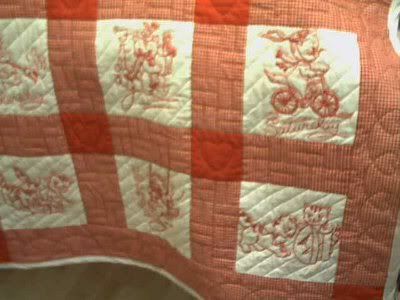
tada! i have once more completed a quilt. so, i now introduce to you Pink Kitten:

 i've been working on this one for about 7 years on and off. i did the piecing by machine and all the embroidery and quilting by hand. its based on a style of quilt popular in the 1920's called a redwork quilt because it only uses the colors red and white. when i started piecing it, i was stupid and forgot to pre-wash my fabrics so it can never be washed or the red squares will bleed into the white, hence the name Pink Kitten. its a wall hanging so it shouldn't get dirty anyhow.

Friday, January 18, 2008

victoria has lost her clarity and her fishes are confused


Often at the funerals of young people, suicides, and sudden deaths the eulogists speak of wasted potential, unfulfilled dreams, a life incomplete. This I do not understand. Does a corpse dream? Does a pile of ashes have any more obligations to fulfill? Can a dead body, if properly motivated, be convinced to get up and achieve? No. When a life is over, it is over, complete. With death, however unexpected, comes the cessation of all dreams, the end to all aspirations, the loss of all potential. A body without potential has nothing left to waste. A cadaver is not lazy, cannot be accused of selfishness or squandered talent. It is only those who are still living that those terms can apply to.
People alive, people with talents and power, people: lawyers and politicians, doctors and clergymen, businesswomen and billionaires. It would be far more appropriate to draft speeches on wasted potential for them, and not the dead. So many, far too many, people have been corrupted by greed and hatred, have let their selfishness and bigotry delude them into thinking that they are the only ones worth saving, never grasping how interconnected all life truly is. These people have a beautiful gift and a great responsibility to their fellows, a job to do in the service of all: not just for other's gratification, but for their own as well. Those that choose greed over selflessness live small lives, lives of unfulfilled dreams. Those that shun compassion find their souls lacking, incomplete. For these misers death is the only consolation, for only in death will they finally be blameless.      

Saturday, January 12, 2008

a galapogos phantasm


tonight i had some people over to celebrate my new stove. i haven't cooked in my own home since 2004, so this was very exciting. i made chicken vindaloo with rice and naan, and galub jamun for dessert. to commemorate the event, here are the recipes i used. i got them from recipezaar.com.

Chicken Vindaloo by Ranikabani
2 tablespoons vegetable oil
2 medium onions, chopped up
1 1/2 tablespoons ginger garlic paste (one 1 inch cube ginger blended with an entire bulb of garlic and 2-3 tablespoons water)
6 whole cloves
4 whole cardamoms
2 two-inch cinnamon sticks
1/2 or 1 teaspoon cayenne pepper
1/3 teaspoon turmeric
3/4 teaspoon cumin
1/2 teaspoon allspice
2 medium tomatoes, chopped up
1 tablespoon vindaloo paste (not sauce, i use neera's brand)
1 whole chicken, skinned, washed and cut up OR 4-6 boneless skinless chicken breasts
2 tablespoons fresh chopped cilantro
1. heat oil in a large pot (like a dutch oven or stew pot) over medium or medium-high heat.    2. add onions, ginger garlic paste, cloves, cardamom, and cinnamon and cook until onions are golden brown    3. combine cayenne pepper, turmeric, cumin, allspice, and a small amount of water to make a watery paste.    4. add spice paste to onions and cook for another 3 minutes.    5. add tomatoes to the pot and cook for 5 to 10 minutes longer or until tomatoes release juices to make a sauce.    6. add vindaloo paste and cook for 2 minutes.    7. add chicken and a cup of water, cover and cook for 30 to 45 minutes (depending on size and amount of chicken pieces), stirring occaisionally.    8.add cilantro and continue cooking until chicken is done all the way through, 15 minutes or so.

the original recipe didn't include any cooking times after adding the chicken, so those might need to be adjusted. also, i uncover the pot after its halfway done to let the sauce thicken  or adding 1/2 cup of water instead of a whole cup might work, too. i'm still fiddling with this recipe. i serve this over plain white rice.  the next recipe is for naan, a central asian flatbread. you'll need a baking stone for this one.

Naan by SnowHat
2 1/2 cups warm water (100 - 110 degrees F)
2 teaspoons active dry yeast
6 cups all purpose flour
1 tablespoon salt
vegetable oil
1. in a large bowl, dissolve the yeast in the water.    2. add 3 cups of flour, 1 cup at a time, stirring with a wooden spoon in one direction for one minute between cups.    3. sprinkle mixture with salt.    4. stir in 1 or 2 more cups of flour, 1 cup at a time, until dough is stiff.    5. turn dough out onto a lightly floured surface and knead vigourously for about 10 minutes, adding remaining flour gradually as dough gets sticky.    6. wash and dry mixing bowl and generously coat interior with vegetable oil.    7. shape dough in a ball and place in bowl, cover with a moist towel and let rise in a warm place for 1 1/2 hours or until dough doubles in bulk.    8. place baking stone in center of oven and preheat oven to 500 degrees F.    9. deflate dough divide into 4 equal pieces and shape each piece into a 8 by 6 inch oval.    10. let dough rest for 10 minutes.    11. wet fingers and "dimple" the dough by pressing your fingertips into it and stretching it as thin as you can. holes are okay. (i divide my ovals in half before this step to make 8 pieces of naan because i have a smaller baking stone).    12. carefully transfer dough to baking stone and bake for 5 minutes or until naan is golden on top and brown and crusty on the bottom.

Galub Jamun by Mercy
Dough:
2 cups dry milk
1/2 cup flour
1/2 teaspoon baking powder
1/2 cup melted butter or margarine
1/4 cup milk
Syrup:
1 cup sugar
1/2 cup water
1 pinch ground cardamom
1 pinch saffron threads
2 teaspoons rose water
1. combine all syrup ingredients in a small saucepan and bring to a boil.   2. lower heat and simmer for 10 minutes or until thickened.    3. preheat oven to 375 degrees F.    4. combine all dough ingredients in medium mixing bowl.    5. scoop balls of dough onto a greased cookie sheet (i make 9 or 12) and bake for 6 to 8 minutes or until golden.    6. arrange the dough balls in a shallow dish or bowl and pour syrup over the top. the dough will absorb most of the syrup.

hahahahaha. i said balls. saffron is terribly terribly expensive (check it out next time you're at the HEB) and i've heard turmeric can be used in its place, but i've never tried. here's to my new stove!

Wednesday, January 2, 2008

tarnished bovine kneecap


Sometimes little sparks keep me up at night and i have to dig them from my gray matter like shrapnel and paste them in my notebook:

i wouldn't want to know what a face looks like underground. i'd rather be part of the earth sooner. preservatives, jelly, make-up seem false like a band-aid applied to a wound that has no chance of healing. the clothing is just a mockery like a dress on a cat. the body doesn't know, doesn't care. And the people there -the family- they do know, but it never looks like sleep. it more resembles a puppet show. When they've all gone, what is it like under the dirt? like a drunk (or a child) fallen asleep in an odd position with shoes on and no one there to care for them, undress them, move them into warmth, into bed, give them the comfort they need to make it through to tomorrow.

Saturday, December 29, 2007

flaming strawman


(its supposed to be funny)

I posit that it is positively possible that the Puritans did not separate from the Anglican Church over a difference of opinion concerning predestination, but rather because of an obsession with fire. Only in the new world could they find the isolation and raw fuel they required to experiment with pyromania to their little hearts' content. Even the vanishing of so-called lost colonies can be accounted for by careless wildfires set by religious zealots.  What does the term "Puritan" symbolize, if not an affinity for purifying flame? A flame believed to be bright and pure enough to burn right through the corruption of the Anglican Church for those who stayed behind, or strong and holy enough to burn through the polytheistic beliefs of the savages encountered by the early colonials. I suspect that even the Puritans' own children were subjected to this holy light to burn the demons out of them. It naturally follows that these disfigured children would be embittered by their brutal upbringings and pass their disgruntled legacy on to future generations, paving the way for our selfish, xenophobic society with its greed-based economy.

Thursday, December 27, 2007

there should only be greeks

this is an essay i wrote my first semester of college for my composition 1 class. the instructor really liked it. he also liked hemingway, understatement, and animal tragedies.

Summer Job by Brak

I have always wanted to be a veterinarian. As far back as I can remember, I have wanted to be the doctor in the white coat helping the sick and injured animals find their way back to health. I wanted to take care of people's pets and maybe some livestock, too. The summer of my senior year in high school, I got a job as a veterinary assistant and my dreams abruptly changed. I witnessed the dark side to those sparkling white exam rooms, the shiny metal gurneys, and the clean, bleached coat. I learned a lesson I won't ever forget and learned something about myself as well.

            My duties at the clinic were simple: greet the client, ask what needed to be done for their animal, and take them back to the exam room to get the pet's weight and temperature. Then, if it was needed, I would draw up the vaccinations, suck up the liquid into a syringe and squeeze out the air. The bulk of my work was cleaning. I would clean the exam room after every patient, clean the kennels in the back, clean up after dogs in the waiting room if they forgot their housebreaking, and clean whatever else needed a good scrub. It wasn't until I had been working at the veterinarian clinic for a few weeks that I had my change of heart.

            On a sunny afternoon, a family brought in their elderly dog, Pepe, who was suffering a mysterious malady. He had been fine all morning, but took a sudden downhill turn around noon. Pepe was a large poodle, but wasn't groomed poodle-style with all the puffs and bows; it seemed he had been allowed to groom himself for at least a few years with no intervention by scissors or brush. He had probably been white in his youth but was now a dull dirty gray with brown circles under his eyes. Pepe's family, four or five people in all, accompanied him into the exam room. I took their old dog into the back and checked his weight and temperature, and then reunited him with his people. They welcomed him back, and we all waited for the doctor. When the doctor got there, he did his usual examination, asked all the usual questions: Has he been eating anything out of the ordinary? Is he lethargic? How is his appetite? What was he doing right before he got hurt? The family answered quietly, solemnly. I could see that they were scared for their elderly pal. They told the doctor that Pepe had been fine earlier in the day, but later that afternoon had gone around the side of the house, alone, yelped and had been acting strangely ever since. He couldn't walk very well on his own, yelped when he was touched, and had developed misty gray shields in his eyes, cataracts. No one knew the source of the dog's trouble.

            The doctor's brow furrowed in a serious way as he contemplated the family's story. He took a moment to decide how to tell them his diagnosis. The dog was in bad shape. From what the doctor could see and what the family had told him, it appeared that Pepe had either gotten into some poison or been electrocuted. There were procedures that could narrow down the source of the dog's discomfort, and more procedures that could possibly correct whatever was wrong, but it would be costly. The mother and father of the family took a moment to deliberate. How could they pay for it? Would it be worth the cost in the end? Pepe was an old, old dog, after all. Finally, with tears in their eyes, they gave us the verdict. Pepe would have to die. The doctor and I gave them a few moments alone with their ancient pet. The children gathered around to say good-bye as we closed the door. I waited outside the closed door, feeling sorrow of my own. When the door opened, the doctor, a technician, and I led Pepe into the back room where he would draw his last breath. Pepe went quietly, smelling the ground, orienting himself in his new surroundings. Once he was separated from his family, however, things changed.

            I don't know if dogs have a sixth sense, or if someone had told him in a way he could understand that he was going to die, but he knew it and he did not want to go. Once the syringe was filled, that dusty dog found his strength. He struggled with his leash, bucked his head and front paws into the air, and clawed for his life. Breath came out of his nose in high-pitched whines and whistles as he pawed at the doctor, the technician, and me. The family must have heard the commotion because suddenly a little girl was at the door. Pepe's little girl had come to witness his final moments. Her big, scared eyes looked at us with the purest horror. Pepe was bleeding and blood was spraying, flying everywhere. I didn't know where it was coming from; I hadn't noticed any wounds on him when he arrived. That little girl stood in the doorway with a shocked expression on her face for what felt like hours, but was probably only a minute or two. Finally, the doctor yelled for me to close the door.

            I took the little girl back to her family, Pepe's family. The family left one member short; they exited the clinic while their old buddy was still in his death throes. They took that little girl home without her friend. Pepe struggled mightily for his life. I know because, as an assistant, it was my job to clean up the huge mess he made. He had knocked over a gurney and spilled a few boxes of gauze, but the worst was the blood. He left pieces of himself all over that room. Blood was splattered everywhere, on the walls, the floor, the cabinets. Blood in pools, blood in trickles like tears, blood with fur matted into it was all around. It took three people several hours to clean up after the dog that didn't want to die. He did die, though. He died away from those he loved, with strangers, but he died a brave death. He died fighting. .

After Pepe, I no longer wanted to be a private practice veterinarian. I still loved animals and knew in my heart that medicine was how I wanted to serve them, but I also knew that if I became a doctor for pets, someday a little girl would bring me a dog she loved, a dog like Pepe. This dog would not be beyond help, a car accident victim, a cancer patient. This dog would be within my power to save, but his family wouldn't be able to afford to save him. I realized that I didn't have a strong enough constitution to take the life of an animal when it didn't need to die. Watching Pepe fight so heroically for his life made me realize exactly what it means to be a private practice veterinarian: to have to sometimes put money before love. The doctor was a good man and didn't do anything wrong; he only did what needed to be done. Still, I never wanted to have to do anything like that. I changed my mind about being a private practice doctor then and there. I decided that the place for me was far away from the much loved and coddled pets I originally intended to serve. I wanted to work at an animal shelter from then on, a good, no-kill, Humane Society style animal shelter. From that day forward, I dreamed of a place where pets have no owners, no little girls to stare, terrified as their companion falls, and the killing is done only as a last resort means to end suffering. That's where I belong.

Wednesday, December 19, 2007

select your handstand


An Untitled Work in a Slightly Skewed Dimension pt. 3 by Brak

Over the next few weeks, it became obvious that Hector had no intention of changing his mind. He moved a full suite of living room furniture into Kay's room, and although the room was enormous, it could not accommodate her bedroom furniture as well, so Kay and her things were forced into the corner. Happily, Kay didn't need to fear any more unwanted advances because Hector never joined her in the bed. He had an odd habit of simply falling asleep wherever he was whether he was standing or sitting or laying down, mid-sentence or mid-meal, he would suddenly lose consciousness and not awaken for hours. Presumably because of this, Hector didn't have a job and instead stayed home with Kay in her room all day. Despite the cramped conditions, it wasn't so bad; as long as Kay didn't stand in front of the television, Hector barely seemed to know she existed. He only ever called on her to bring him a cold beer or another bag of corn chips: the two staples of his diet. Otherwise, Kay continued life just as before. She spent most days on her bed amidst her furniture pile reading, or painting (she'd hidden her easel in the closet) and, even though she could no longer watch the Happy Trees painting show because Hector despised it, her technique was improving.

Other days, she would wander down to the music room and practice various instruments her father had collected but never played (he was far too busy) or into the home gym her father had had custom designed, but hadn't yet gotten around to trying out, or into the magnificent library which was also untouched. The only danger in wandering the house was that she would meet someone else, either one of the household staff who always tried their best to be rude, or one of her parents who would scold her for leaving her husband alone for too long and admonish her to go make grandbabies immediately! She much preferred her little pile of furniture to that risk, so usually took what she needed from other rooms (corn chips, dumb bells, books, or violin) and hurried back to her cozy jumble in the corner.

One day, in the middle of fall, when Kay knew her parents weren't home, she dared to stay out of her room for nearly five hours. She thought it would be a nice vacation from the usual monotony if she treated herself to a longer stay in each of her favorite rooms and finished the day relaxing in front of the screen in her father's home theater, the only one of his rooms that he actually frequented. Kay enjoyed her full day of leisure and didn't even run into a cook or a maid or a butler once. She returned to her room in high spirits which were quickly dashed once she opened the door.

"Where are my things?" Kay yelped, for all her belongings had vanished from the room.

"Threw them out," mumbled Hector from around a mouthful of corn chips, "Had to make room for this."

"And what is that?"

"Its great isn't it?" Hector beamed proudly at her from a pool-side lounge chair he had planted in the middle of a wading pool filled with corn chips. All his furniture had been pushed back to make way for this abominable snack food container in front of the television. Kay was debating whether she should shout or try to appeal to his sense of reason (if he had one at all) when Hector, once again, passed out.

Kay, sighing deeply, went to take refuge in a long bath. The hot water was only comforting in theory and Kay emerged from the bathroom just as frustrated as she had been when she entered. Since it was late and there was nothing else to do, Kay curled up on one of Hector's sofas and fell asleep. After what seemed like only minutes, she was awakened by a sharp slap to the face. "What the..?" Kay exclaimed, bolting up. Her bleary eyes were confronted with an incensed Hector who shouted, "You can't use my couch, you big retard!"

"Why not? You took my bed away."

"That still doesn't mean you can sleep here! This is mine! You have no right to even touch it, stupid pig-faced woman!"

"Where am I supposed to sleep then?"

At this, Hector clenched his jaw, scowled at her, picked up a throw pillow, tossed it into the closet, and gestured after it. "You need to learn to respect the possession of a person's personal belongings!" Hector spat as he lifted Kay up and threw her after the pillow. The door came slamming shut before Kay could even make a move towards it. She heard the lock her mother had had installed to keep the maids from snooping click followed by an unearthly howl, "I NEED MORE BEER!" and Hector's heavy footsteps as he exited the room in search of his foamy friend. Kay was consumed by despair. She knew she was too small to try beating down the door and that it was useless screaming for help. Who would hear her? Her parents weren't home, and the cruel servants would be only too glad to find Kay in such a vulnerable position. No, Kay thought, better to just go to sleep and try to sort things out in the morning. She curled up on the triple plush carpet with her goose down throw pillow and was soon in dream land.

            Hector came to wake her up once again, but with a kick instead of a slap this time. Kay gasped awake and scurried back from the source of her pain. Hector stood glowering over her. "Get out of the closet, bitch." he sneered. Kay, terrified, scrambled out on hands and knees. She tried to stand, but Hector pushed her down again, gripped her leg with his hairy hand, tore off her socks as she struggled, and began slashing at her feet with a bread knife. "You must learn about possession!" he cried, obviously drunk. "Hector, what are you doing?"  Kay inquired, but Hector was already asleep. Kay kicked herself free of Hector and ran down to the front room to wait for her parents to return. She would just have to tell them that the marriage wasn't working out. She knew her parents would be disappointed that she wasn't enjoying their latest gift, but surely, a week spent with Dr. Lackhanger, or any other punishment they could devise, would be less distressing than a lifetime spent with Hector.

            It didn't take long for her mother and father to arrive and, after they'd given their luggage to the butlers to be unpacked and put away, Kay nervously approached them. Before she could even get a word out, her mother was already shouting, "Where is Hector?! Don't you know he needs you? You must go! Go now and find him and make grandbabies! You can't be down here with us! Shoo!" But Kay, for once, stood firm against her mother, "No, Mother, I'm not going back to Hector. I'm sorry to be so rude, but I really cannot spend the rest of my life with him. I want this marriage annulled and I want him to leave. Please." As Kay's mother listened she grimaced and scowled, but when it came time for her to respond, her face broke into an enormous grin and she said, "Don't worry, honey! I'll take care of everything. Go shower and get dressed and when you come back, I'll have it all done."

            "Really?"

            "Of course!"

            Rather than go back to her room and confront Hector, Kay stopped by the laundry room to pick up some of her clothes and used the downstairs bathroom to shower. She sang out her jubilation under the warm waterfall. Finally, she would have her old life back! The household staff would no longer torment her, Hector would be gone, and maybe she'd be allowed to take another ride to the park with Art once she didn't have to spend her days pretending to make grandbabies and fetching endless beers and bags of corn chips. Kay practically sashayed back into the front room, her wet hair swishing happily behind her. She walked around the great chair, expecting to find her mother seated there, but was instead startled by Dr. Lackhanger. He leapt up suddenly, grasped her by the shoulders and began shaking her emphatically. "You ungrateful little bitch!" he snarled, "This time you have truly gone too far! Rejecting a Barbie Dream House, an object any girl would throw herself on knives for is evil enough, but to scorn such a loving, wonderful husband you must have a terribly hate-filled soul! You are coming with me to my experimental residential program. There we will give you all the ice it takes to cool your repressed anger and subject you to as many aesthetic alterations as you need to get a firmer grip on your self worth. For it is only once you love yourself, that you can begin to love and appreciate others!" Kay struggled mightily, but she was no match for the doctor. He pushed and pulled and finally, carried her right to the front door, but he couldn't drag her out of her house because she gripped the bronze door handle and would not let go. "But I don't want plastic surgery!" she cried, "I like myself just the way I am!"  

           "Nonsense," Dr. Lackhanger countered," your behavior betrays your insanity. Perhaps once you have larger breasts and a smaller nose, you will come to understand what it means to be a good wife." As Dr. Lackhanger repositioned himself to get a better hold on Kay, her leg slipped down and she kicked him hard. He collapsed with an "Oof!" and Kay ran away from him, and her home, as fast as she could go. Her mother, who had been keeping a respectful distance during the struggle, suddenly ran forward and called after Kay, "We only want what's best for you!"


...and that's all i wrote

Tuesday, December 18, 2007

change the meaning of potato


An Untitled Work in a Slightly Skewed Dimension, pt. 2 by Brak

Indeed, Kay spent most days on her own since the departure of her "friends" as her mother called them, who were actually household servants her parents had bribed to spend extra time with Kay. There had been a tutor, Mr. Leftwig, who was delighted whenever Kay made a mistake in her lessons because it gave him license to smack her with his unusually hefty ruler, a practice her parents believed would build character. Of course, after being maliciously attacked with a ruler, which more resembled a cricket bat than an actual ruler, Kay would often be so frightened that she would forget whatever she had just learned and make even more mistakes and be beaten even more severely.

In fact, on one occasion, Mr. Leftwig had thrashed her so brutally that a doctor had to be called. When the doctor arrived, he addressed Kay as a "tempestuous little cow" and ordered her, with much profanity, to overdose on narcotics. Kay, being a mere child at the time, soon lost consciousness. When she woke up, she found herself in her bed, but even though her head was bandaged, her ankle splinted, and her arm in a cast, she discovered she had even more bruises and aches than when she had passed out. Furthermore, she reeked like a barnyard.

There had also been a maid, Lee, who tormented Kay by safety pinning live insects and small rodents to Kay's freshly laundered clothing. Lee also found it hilarious to lift the long skirt of her uniform and show Kay her pimply rear at any given moment. Mr. Leftwig, and the butler, Carter always seemed quite pleased when Lee behaved in this way around them and clapped and cheered to encourage her, but Kay found the whole spectacle distasteful. She said as much once, but Carter taught her to hold her tongue by dangling her out of her third story window by her shoes. Yes, some friends they were. "Bunch of creeps and lunatics." muttered Kay as she wandered among the trees on the far side of the park.

"Who are creeps and lunatics, darling?" inquired Kay's mother as she appeared from behind an ancient oak tree.

"No one mother." Kay stuttered in shock, "I said 'bears munch creeks and arithmetic.' What are you doing here?"

"They certainly do, darling. I just stopped by because Art called and said you had a little trouble with the locals."

"No, Mother. It wasn't trouble. It was just… it was nothing."

"It's all right sweetie, I understand. It must be difficult for you trying to get along with others when you've had such a fine upbringing and they've been living in squalor with druggies and whores. They must be awfully jealous of your fortune at having two adoring parents, and jealousy often expresses itself as rage."

"I don't think there was any r…" Kay began, but her mother interrupted her, "No, dear, don't try to protect them. They aren't your friends and they never will be. But don't worry, that's no reason for you to be lonely and blue. Come home with me now. I've got a surprise!"

Kay very much wanted to continue wandering among the trees, smelling the green air and enjoying the solid security of bark and branches, but her mother was very insistent and it was no use arguing with her.  As soon as Kay moved towards her mother, Art burst out from behind a thicket of vines, tackled Kay, forced her to the ground and bound her wrists behind her back. Kay's mother, kneeling before her perplexed face, slipped a blindfold over Kay's eyes saying, "Its not a surprise if you peek!" Kay's mother kept up a constant excited twittering as Art helped Kay to her feet and escorted her back to the car.

In stark contrast with the exhilaration Kay had felt during her first drive out, the drive home felt like a defeat. Instead of being enraptured by the colors and motion of everyday life, Kay could only make out shadows at the bottom of her blindfold. Kay was still in this spirit of bewildered despair when her mother and Art led her into the front room and sat her on the suede couch.

"Dear Kay," sighed her mother, "You have been such a lovely daughter to me and I cannot bear to see you moping around in such a lonesome way any longer."

'When have I moped,' thought Kay, 'and when have you been around to see it?' but, of course, she didn't dare say anything.

"Take off her blindfold!!" squealed Kay's mother, and the light hit Kay's eyes like a lost bird hits a window. She tried to raise her arm to shield the glare, but her wrists were still bound, so she made do with squinting. Through her halogen-tortured eyes, Kay could barely discern her mother and father standing together with something… someone? between them. A man? Art? Who else could it be but Art? As Kay's pupils adjusted, she realized that the man was a stranger. Her mother, who was practically vibrating with excitement, rushed forward and screamed in Kay's face, "Your new husband!! Surprise!!" The feeling of bewildered despair intensified as Kay's mother continued, "I know you aren't even 18 yet, so it's a bit early, but I asked a favor of the Judge and he allowed me to sign the marriage certificate for you."

Kay's mouth opened and closed in shock as she fumbled for the appropriate thing to say. She just wanted to run away, so she stood up, planning to seek refuge in the kitchen, but before she could move was embraced by her father. He had never so much as shaken her hand for her entire life, but now he was pulling her close and playfully swatting her bum. When she was released from that supremely awkward hug, Kay stumbled and fell back on the sofa. Apparently misinterpreting her prone position as an invitation, her New Husband fell on her like a starved wolf and began slurping at her face.

"Oh goody! Grandchildren!" squealed Kay's mother as she hastily ushered Kay's father out of the room and followed him, giggling. Kay squeaked her protests through mouthfuls of tongue and tried her best to defend herself without the use of her arms, which were still bound. Fortunately, defense proved unnecessary because the New Husband suddenly fell asleep mid-lick and rolled off Kay to snore loudly on the floor. Kay cautiously got to her feet and, discovering that her restraints had loosened during the excitement, carefully slipped her hands free of the knot. Kay began a hasty tip-toed retreat, but stopped when a paper on the coffee table caught her eye. It was a marriage certificate, apparently legitimate, signed by herself and a Hector Marmont. Kay dropped the paper in disgust and hurriedly resumed her stealthy exit.

Kay locked and barricaded the door of the downstairs bathroom with the armchair and end table her mother had insisted on placing in that oversized room to make it more comfortable. Kay curled up, fully clothed, in the immense Whirlpool bathtub and wept. What was she to do? She didn't want to be married, especially to a stranger, but to go against her mother's wishes was unthinkable. Her mother would certainly call Dr. Lackhanger right away for another therapy session, and that was bad enough, but Kay feared that the severity of her disobedience might force them to take extreme measures. The rejection of her husband would assuredly be viewed as a larger offense than the rejection of a wristwatch or a designer gown, and Kay couldn't even begin to imagine what her parents might deem an appropriate countermeasure against such a travesty. The only way she could avoid punishment was to leave her home entirely. This option produced an equal amount of anxieties because Kay had barely even been outside her house since she was born. She had no friends or even acquaintances outside the walls of her home, no allies to call upon for help. To think that a naive girl like Kay could find her way all alone in an unknown world was preposterous. Kay concluded that her only option was to go along with the marriage and try to make the best of it. Perhaps Hector was a reasonable man and she could simply explain that she wasn't ready to be married and ask him to leave.

Kay washed her tearstained face, took a deep breath and walked back into the front room. Hector was fully awake and sitting up on the sofa when Kay returned. "Hector?" she ventured, "Its been very pleasant to meet you, but seeing as how I'm underage and we barely even know each other, don't you think perhaps it would be best if we annulled this marriage?"

"I was promised a wife and that's what I'm going to have. Now get me some corn chips, I'm hungry!" retorted Hector.

"But don't you think marriage is a big decision that should be carefully considered beforehand by both people?"

"No." replied Hector and that's all he would say no mater how Kay pleaded with him.